🛡️Fully Insured·Full Liability + Equipment Coverage·Certificate Of Insurance Available On Request
Pond Cleaning, Cleanout & Maintenance — Central Illinois

Pond Cleaning & Cleanout In Illinois — We Dig It Dry

Pond cleanout across central Illinois, excavator-based and dug dry — silt and muck removal, fallen-tree and debris cleanout, dam and outlet repair, and ongoing pond maintenance services. Spring pond clean-out calls are welcome any time; we draw the pond down and dig it out in the dry, when the bottom will hold a machine. Mattoon, IL — 60-mile radius.

📞 Call (217) 809-0779 Free Estimate

Pond Cleanout, Pond Cleaning & Maintenance in Central Illinois

If you searched pond cleanout or pond cleanout service, this is the page — the crew, the machines and the price, not an explainer. The how-it-works write-up lives on the blog; the work lives here.

TL;DR

A pond cleanout is how you get lost depth back. We drain or draw the pond down, let the bottom firm up, and machine the accumulated muck and sediment off the basin floor with an excavator — then fix the dam, spillway, and outlet while the water's still down and reshape the banks before it refills. We work the basin dry on purpose: it's the only way to see what you're digging and get a clean bottom. Most central-Illinois ponds need it every ten to twenty years. Free on-site estimate: (217) 809-0779.

A pond cleanout is what you need when a pond has silted in, choked with muck, or filled with fallen trees and lost its depth, its water, and its use. A pond cleanout brings it back — we pull the sediment out and restore the basin so it holds water again, and handle the ongoing pond maintenance that keeps it that way.

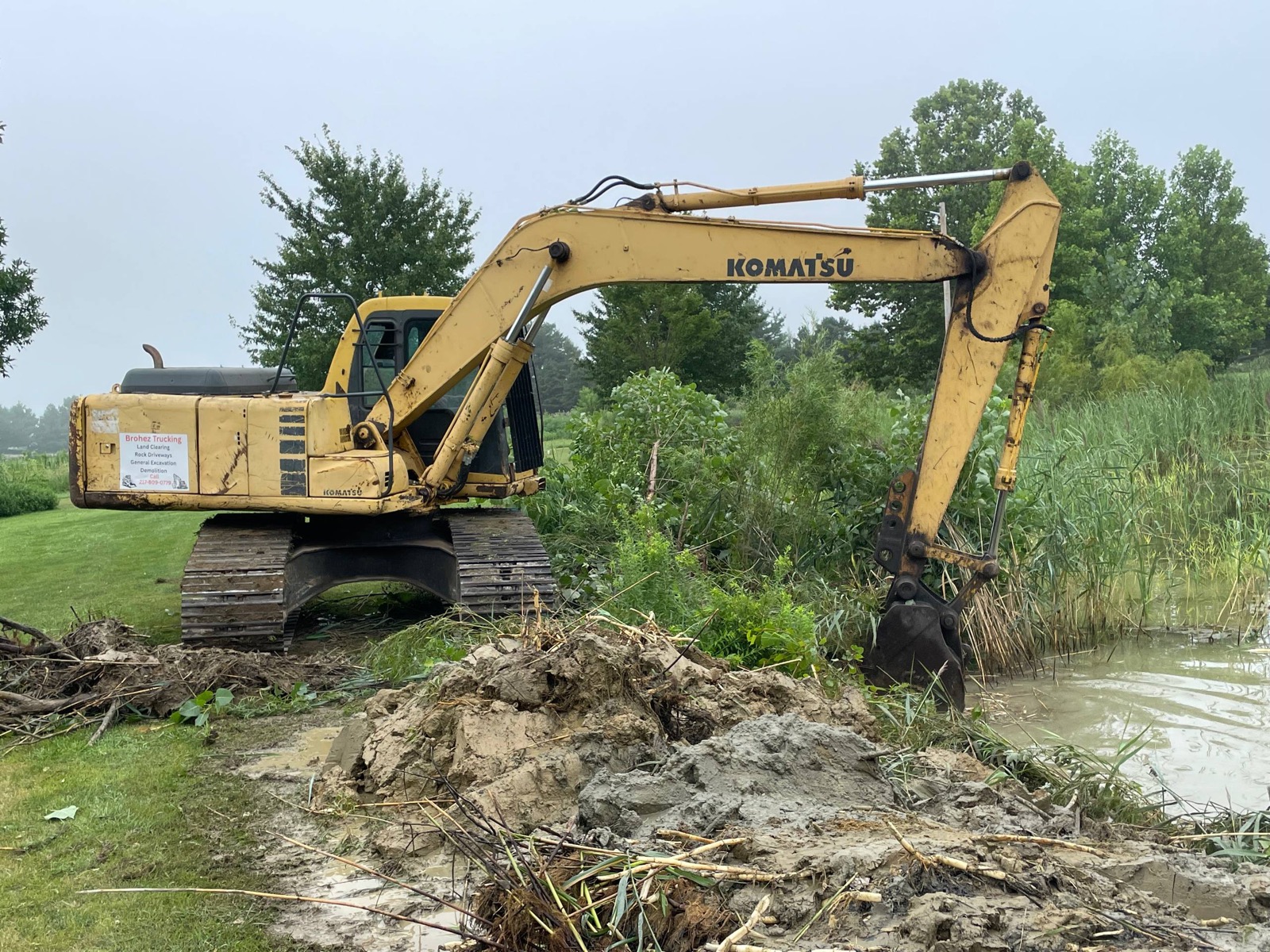
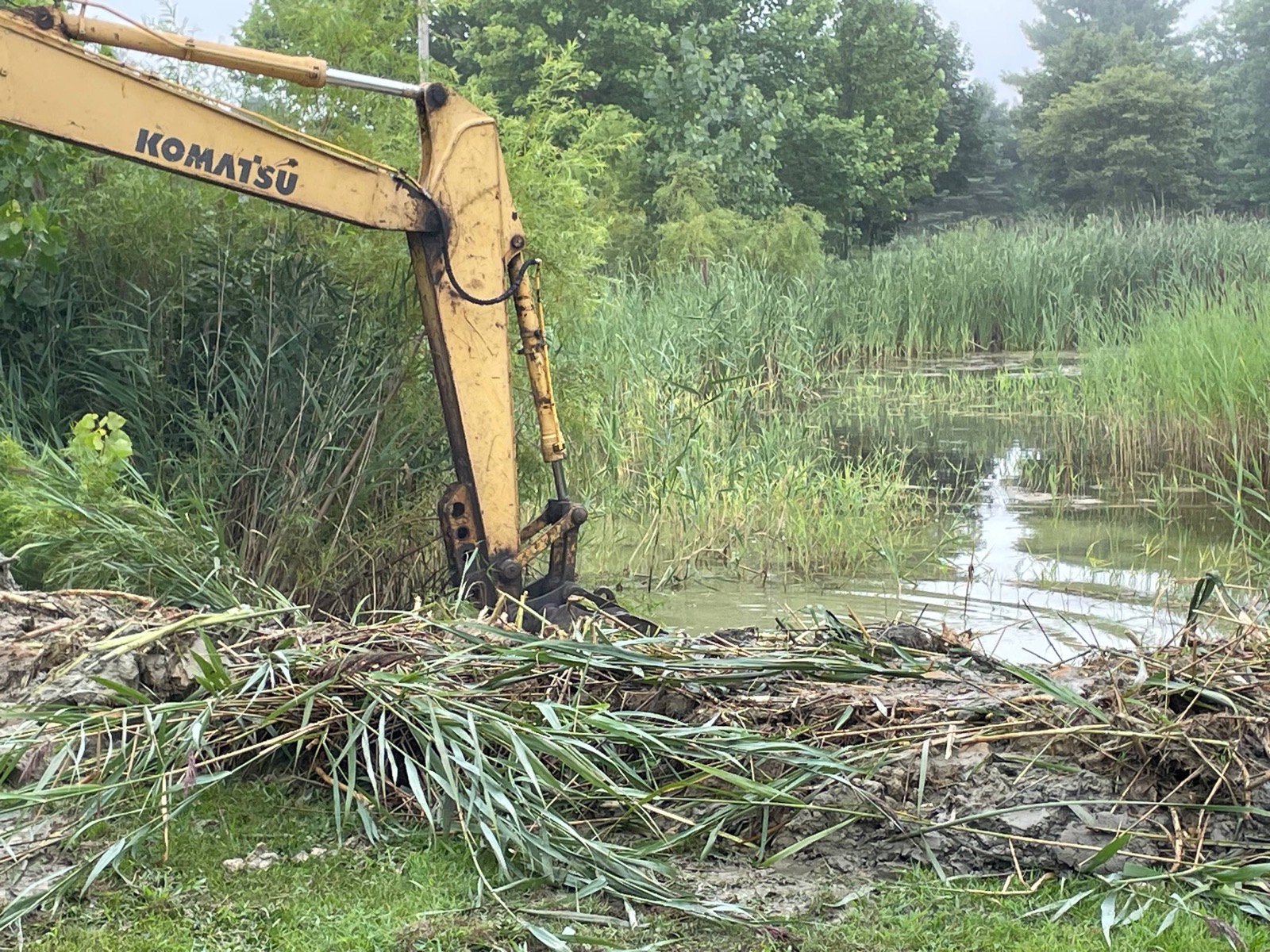
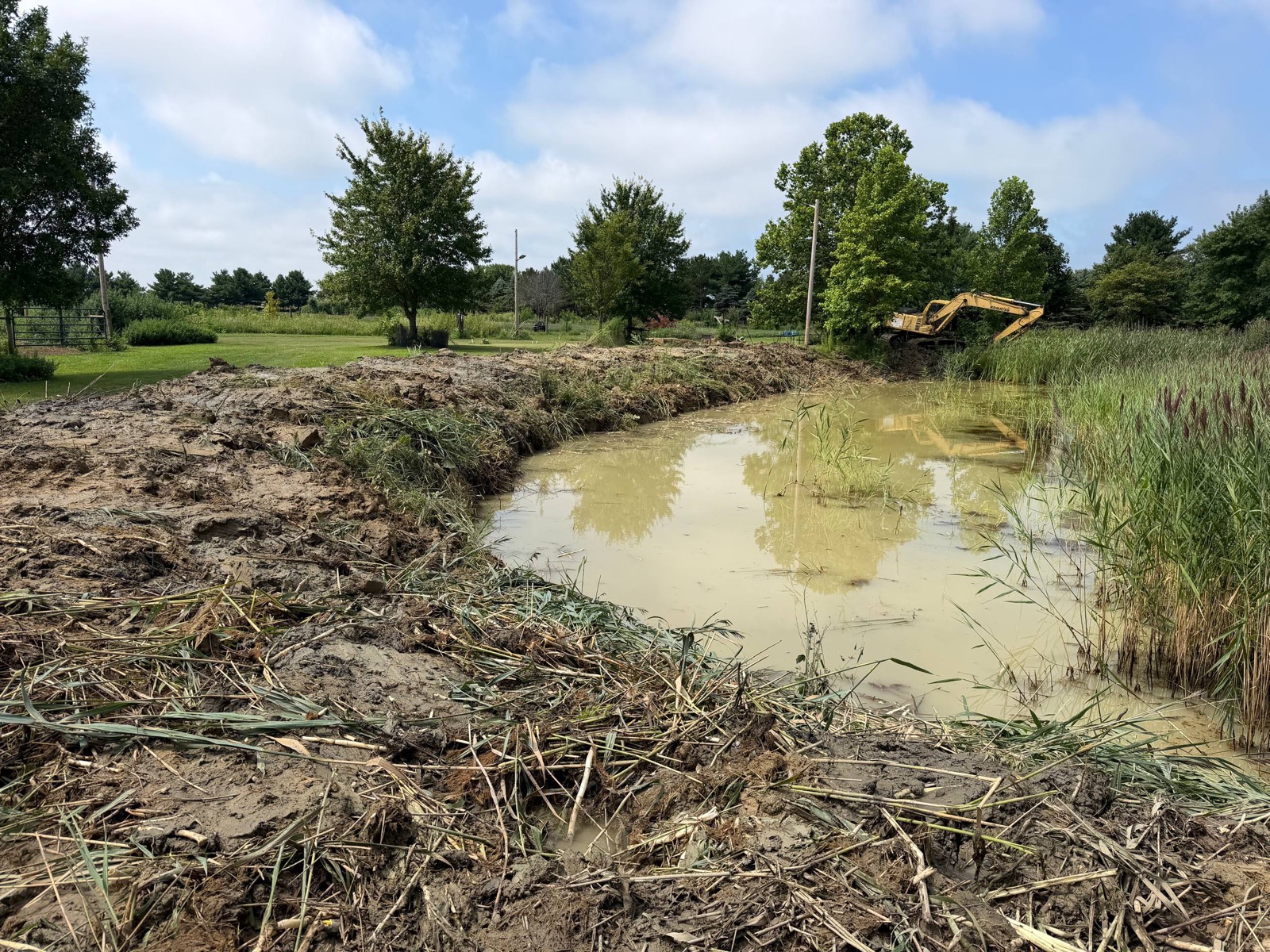
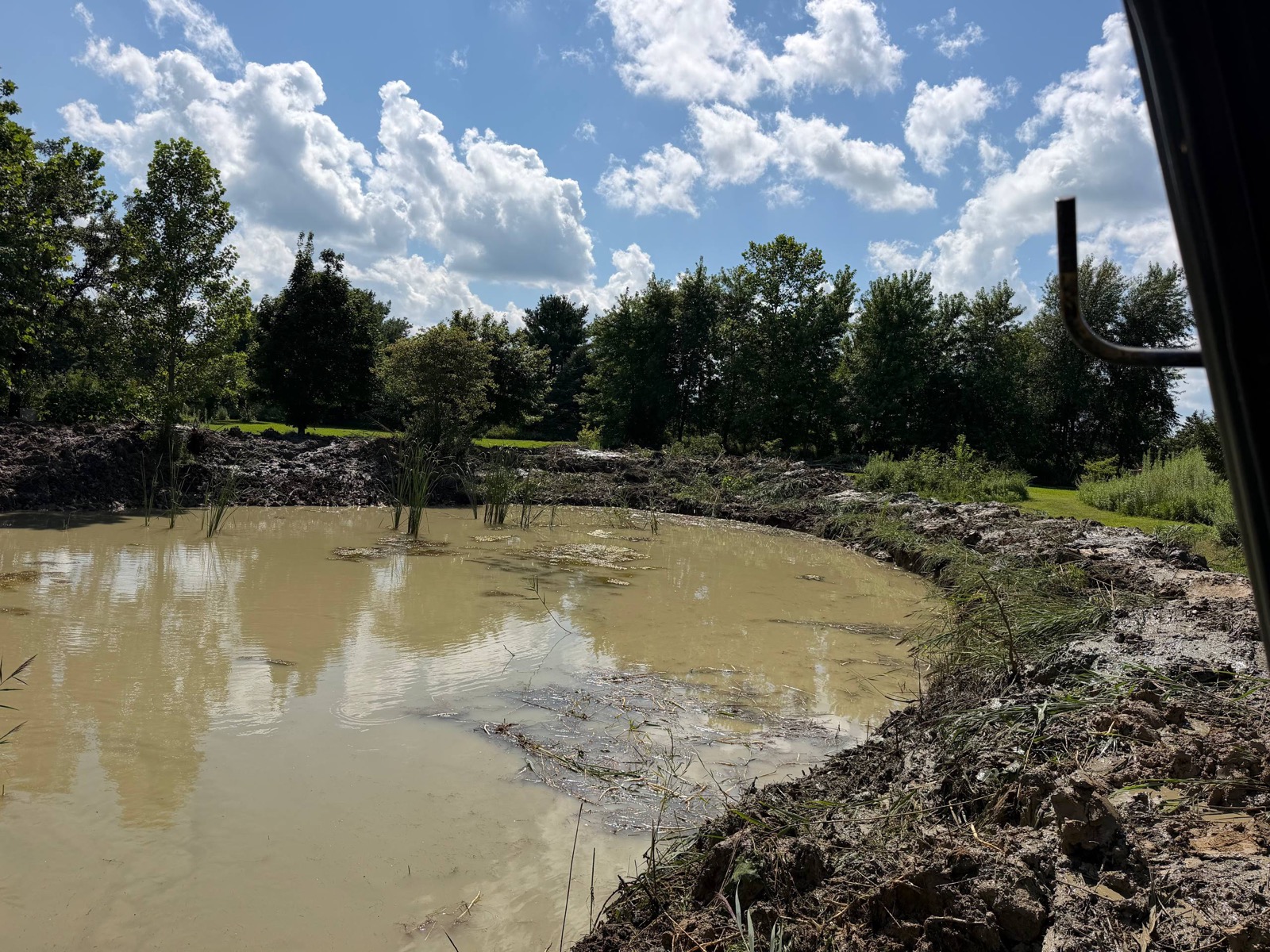
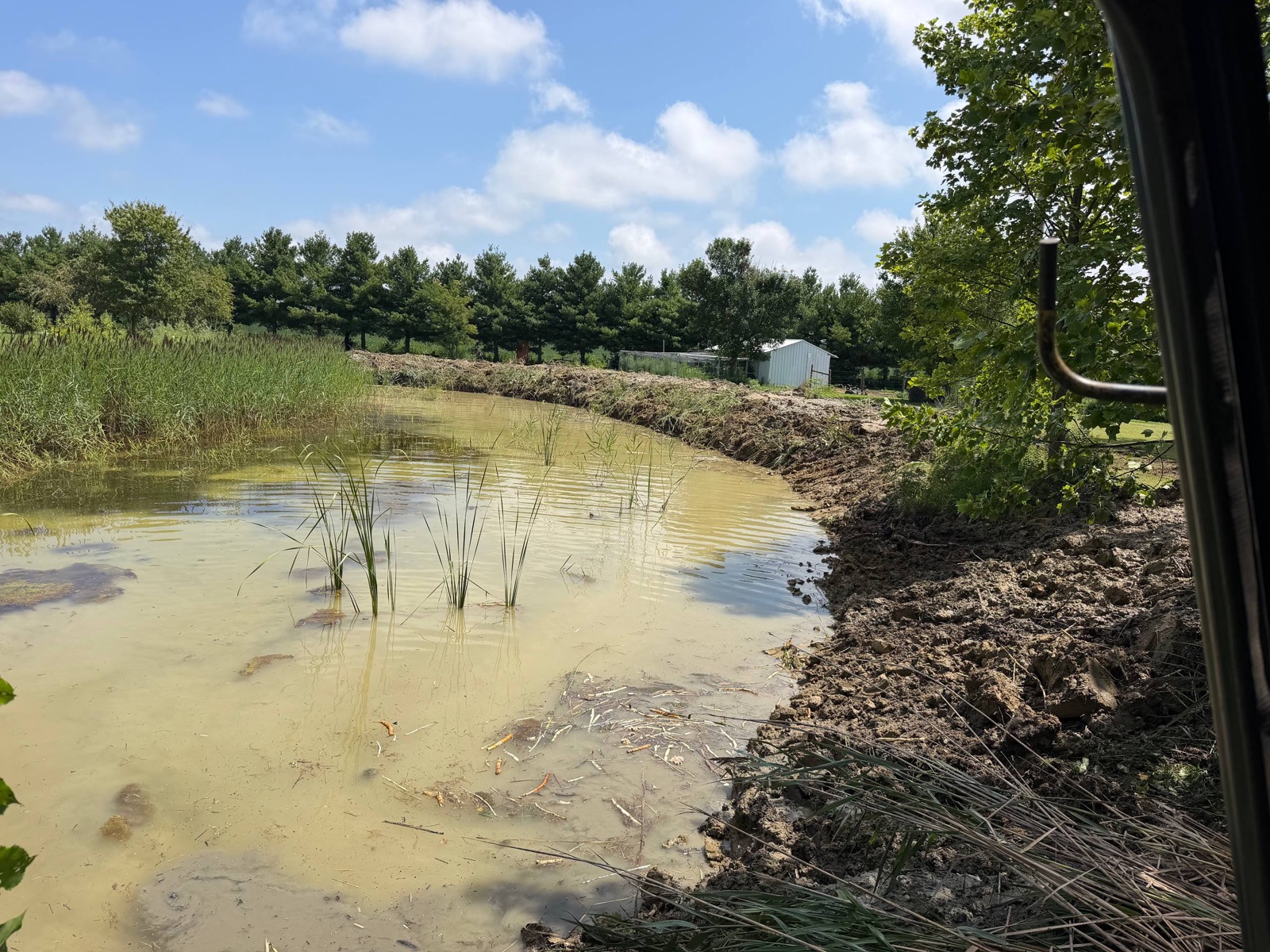
Here's how a Brohez Trucking LLC cleanout actually works. We draw the pond down or drain it, let the bottom firm up, then reach in with an excavator and pull the silt and muck off the basin floor to restore depth, hauling or stockpiling the spoil as we go. We do this work dry, on purpose. A drained basin is the only way to see what you're digging, get a clean bottom instead of a guess, keep from undercutting the dam, and fix the outlet and spillway in the same trip. Machine cleanout on a dry basin is how a pond gets its real depth back.

Beyond the muck, while the pond is down is the right time to fix everything else — fallen trees and organic debris come out, a leaking dam gets repaired, a failing spillway or outlet gets reworked, and the shoreline gets reshaped. One contractor, one machine, all of it handled before the water comes back. If the dam is the real problem and the silt is secondary, how we chase a leaking dam walks through finding it, and the best time of year to fix a dam covers why that work lands in late summer and fall. Restoring a bigger water body on the same footprint? We also handle new builds at lake scale — see lake construction.

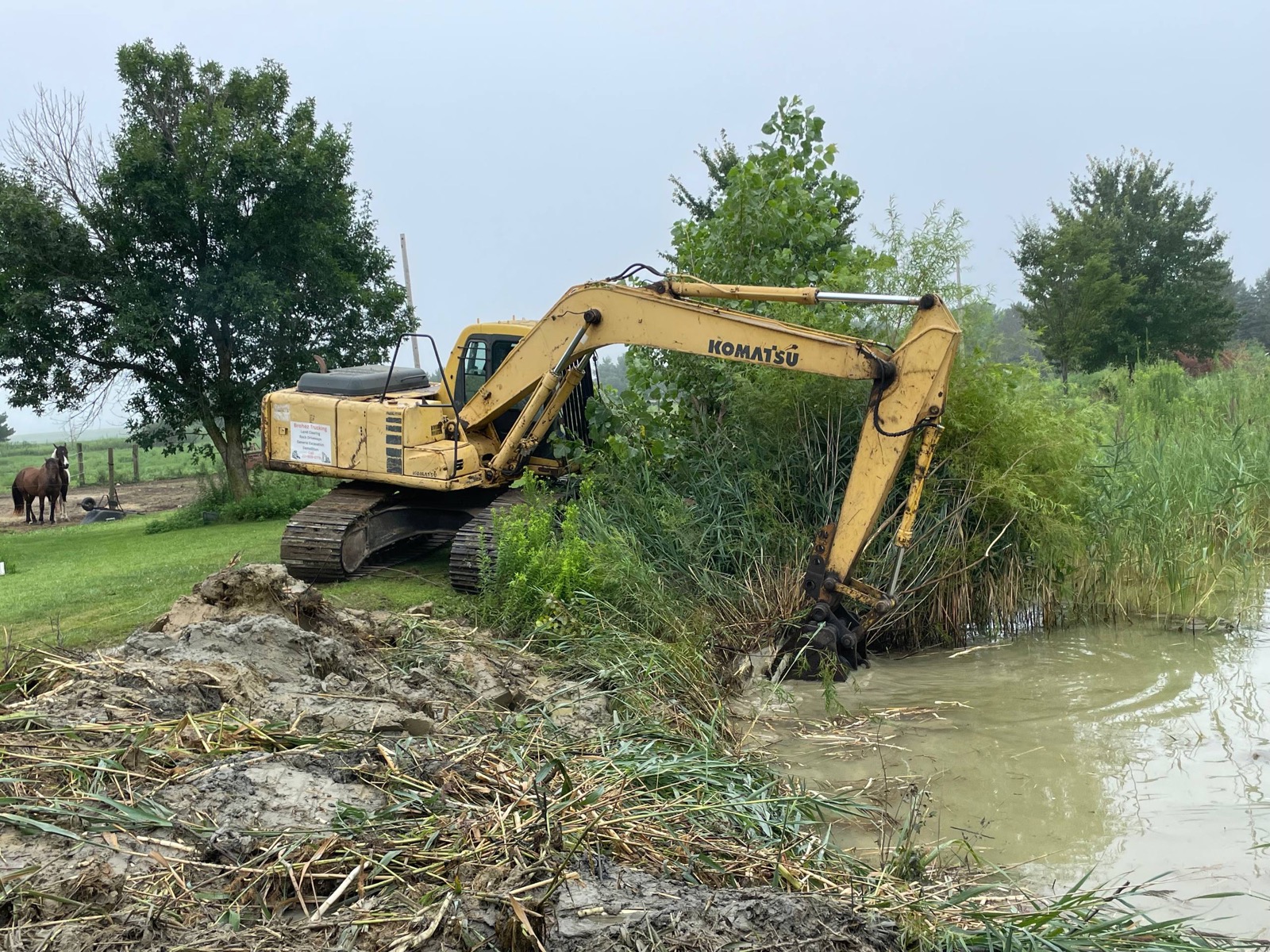
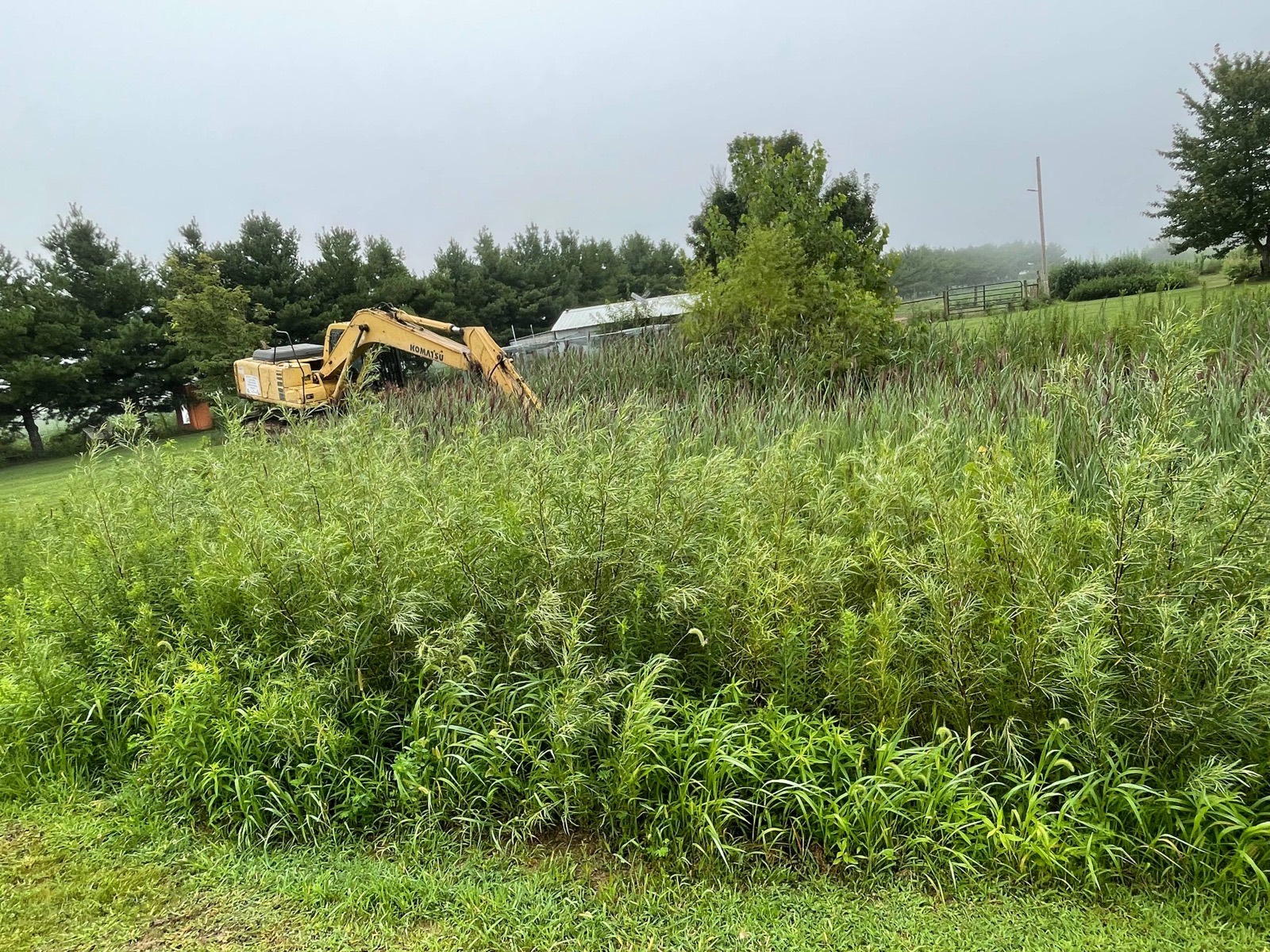
A cleanout is pond excavation on a pond that already exists — same machines, same dry-basin method, same crew that digs new ones. We bring our own iron, so there's no waiting on a rental yard or a second outfit. A Komatsu excavator does the reaching and pulls the muck off the basin floor. A Cat D6N dozer shapes the dam, the banks, and the spoil placement. Our trucks move whatever has to leave the property. One owner-operated crew on your pond, start to finish.

Where the spoil goes gets settled before we start. Pond muck comes out wet and high in organics — it isn't structural fill and it won't stack like clay. Most of the time the best answer is spreading and drying it on site, well back from the water where it can't wash straight back into the basin, then seeding it down. If there's no room for it or you'd rather it were gone, we haul it off. Either way you'll know the plan at the estimate, not halfway through the job.

The fundamentals matter the same as any earthwork. Get the pond drawn down enough to work. Let the bottom firm up. Pull the sediment back to a clean base without undercutting the dam. Set the spoil where it won't wash back in. Done right once beats fighting a silted pond every few years. For the long version — what the drawdown actually takes, how far back the sediment comes, and where the days go — read what a pond cleanout takes to get the depth back.

Our Pond Cleanout Process

Whether it's a silted farm pond or a debris-choked rec pond, the steps are the same.

STEP 01

Site Visit & Assessment

We come look at the pond, check the depth lost, the muck volume, the dam and outlet, and the access. Free estimate.

STEP 02

Draw The Pond Down

The pond gets drained or drawn down through the outlet or a siphon so the excavator can reach the bottom. We let it firm up before we dig.

STEP 03

Clear Debris

Fallen trees, brush, and organic debris come out first so the muck removal has clean access across the basin.

STEP 04

Pull The Muck

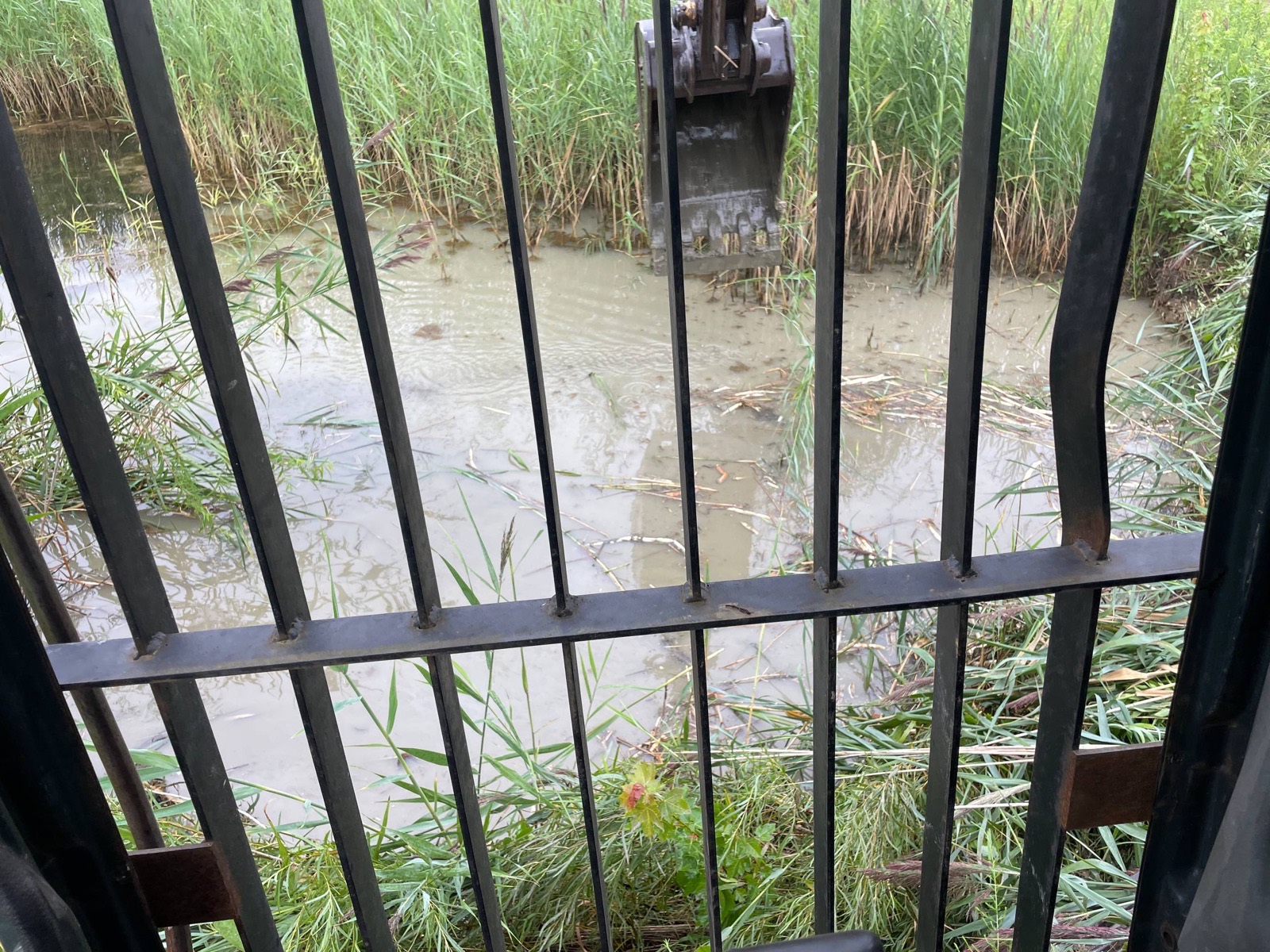
The excavator works the silt and muck off the bottom back to a clean base, restoring the depth the pond was built to hold.

STEP 05

Dam & Outlet Repair

While the water's down, we fix a leaking dam, rework the spillway or outlet, and re-key anything that's let go.

STEP 06

Shape, Spoil & Refill

We reshape the shoreline, set the spoil where it won't wash back, seed bare slopes, and let the pond fill back to grade.

Every Kind Of Cleanout

From a silted-in farm pond to a debris-choked rec pond.

Silt & Muck Removal

Years of sediment build up and rob a pond of depth. We draw it down and pull the muck back to a clean base so it holds water again.

Depth Restoration

A pond that's gone shallow grows weeds and winterkills fish. We dig the basin back to the depth it was built to hold.

Fallen Tree & Debris Cleanout

Downed trees, brush, and organic debris pulled out of the basin and shoreline so the pond is clean and usable again.

Dam Repair

Leaking or slumping dams re-keyed and rebuilt with compacted clay while the water's drawn down — the right time to fix it.

Inlet & Outlet Repair

Failing spillways, clogged outlets, and worn inlet pipes reworked so water comes in and leaves the way it should.

Shoreline Reshaping

Eroded, caved, or overgrown banks re-cut and reshaped to a clean, stable edge that holds against wave action.

Spoil Hauling

The muck and sediment pulled from the pond hauled off or spread on site — your call, sorted out before we start.

Drawdown & Drainage

We help figure out how to lower the pond — outlet, siphon, or pump — so the basin is workable before the excavator goes in.

Verified five-star Google reviews from customers across our excavation, demolition and hauling work in central Illinois. Read them all on our reviews page.

★★★★★
“Great communication and prices were great for hauling rock and dirt.”
— JB · Rock & dirt hauling · Google Review
★★★★★
“Excellent service. Very personal. Used twice on two different projects. Going to use for the third. Highly recommended”
— Robert Shoraga · Repeat customer · Google Review
★★★★★
“Great Service and Great Price! They continued working for 3 days to demolish three buildings and removed all the debris to dumpsters that I ordered. Then, they also come in with dirt to fill the whole backyard. Strongly recommended!”
— Xiao Zhang · Demo + dirt fill · Google Review

Spring Is When You Notice It. Late Summer Is When We Fix It.

Almost every spring pond cleanout in Illinois starts, naturally enough, in spring — and the work almost always happens later in the year. That's not us stalling. It's the only way to do the job right.

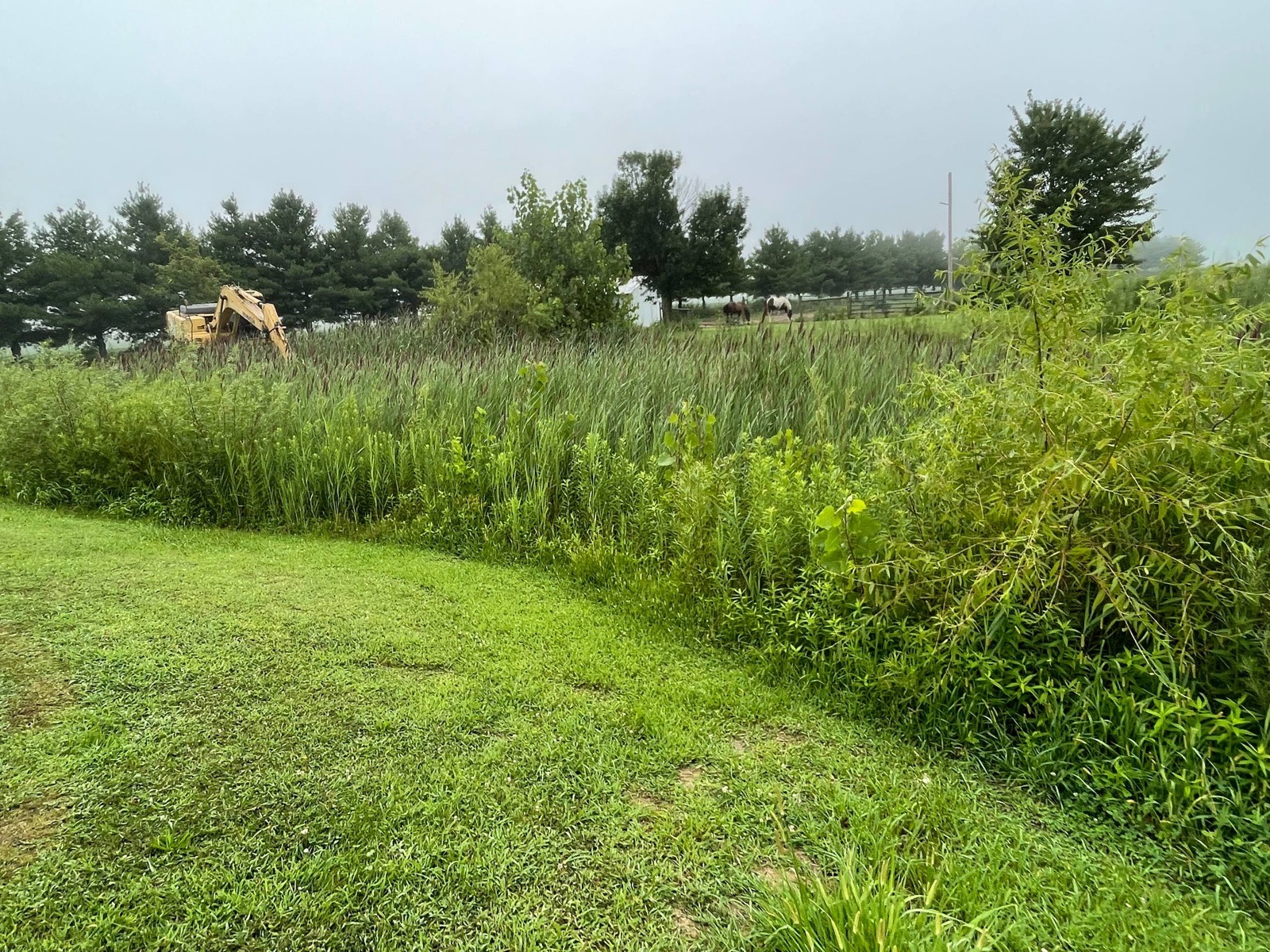
Spring is when the pond tells on itself. The water comes up, the muck stirs, the shallow end goes green early, and the cattails you could ignore last August are suddenly a stand. You walk down there in April and realize the pond has lost a couple of feet of depth to silt since you dug it. That's the moment people pick up the phone, and it's the right moment to get on the schedule.

But a machine cleanout needs the pond low and the bottom firm enough to work. We clean ponds dry — the excavator sits on solid ground and the muck comes out in the bucket. In a wet spring, that same bottom is soup: the machine can't get purchase, the spoil won't stack or dry, and you tear up more shoreline getting in and out than the cleanout is worth. Late summer through fall the water is at its lowest, the silt has firmed, and the material can be spread and dried instead of hauled wet.

So the honest sequence is: call in spring, walk it in spring, work it when the ground is ready. Getting the walk done early is the part that matters — the good fall windows fill up, and a pond that's been looked at in May is a pond that's on the list when the water drops in September. What the work costs turns on the same things a new dig does — access, haul distance, and how much material moves; those drivers are laid out on our pond cost page, and if what you actually want is a bigger or deeper water body rather than the old one back, that is a pond construction job. If your pond is silted in, choked with muck, or losing its depth, the free on-site walk costs you nothing and it's what puts you in the right window instead of waiting another whole year.

Spring Pond Cleanout In Illinois — Freeze-Thaw, Timeline And The Permit Question

Three things decide when a pond cleanout in Illinois can actually happen, and none of them is how busy we are. The first is freeze-thaw. From about February into April the frost is coming out of the ground from the top down, which leaves a thawed layer sitting on a frozen one with nowhere for the water to go. Ground that carried a loaded truck in January will not carry a tracked excavator in March. Work it anyway and you don't get a cleanout, you get ruts you'll be regrading for two years and spoil too wet to stack.

Freeze-thaw is also doing damage while you wait on it, which is why the spring walk matters. A winter of ice sheet against the shoreline shears the bank back a little every year. Water gets into a crack on the dam face, freezes, opens the crack, thaws, and does it again — that cycle is how a hairline in a dam becomes a seep. Muskrat burrows that were tight in October are wide open by April. Half of what people call spring pond damage is one winter of freeze-thaw finishing something that started three winters ago.

The timeline, honestly. Call in spring, we walk it in spring, we probe the muck and put you on the fall list, and the machine shows up when the water is down and the bottom is firm — usually late summer into fall. A silt pull off the inlet end of a small pond is a short job; taking a whole basin back to design depth on an acre of water is a considerably longer one, and most of the difference is not digging, it's what happens to the material after it's out of the hole. We'll give you the day count at the walk rather than a guess off a web page, because the honest one depends on how far the spoil has to travel.

Do you need a permit to clean out a pond in Illinois? For most farm ponds, no. Pulling silt back out of an existing private pond that fills off its own watershed is maintenance, not construction, and it is normally nobody's paperwork but yours. Three things change that answer, and we check all three before a machine moves: whether the pond sits on or connects to a stream or wetland, which can bring the Corps of Engineers into it; whether the job disturbs an acre or more of ground, which triggers the Illinois EPA construction stormwater permit; and what your particular county requires, because that genuinely varies county to county across our radius. If a permit is needed we say so at the walk — finding out afterward is the expensive version.

Where The Muck Actually Goes

Here is the thing that decides what a cleanout takes, and almost nobody asks it on the phone: where does the material go? Digging the muck out of a pond is the easy half. A basin that has lost two feet of depth over an acre is somewhere north of three thousand yards of wet sediment, and every one of those yards has to end up somewhere that isn't the pond.

Pond silt comes out saturated and it does not behave like dirt. It will not stack, it will not carry a machine, and loaded into a truck wet it is heavy, slow and hard on everything. So the first move is almost always to stage it and let it dry — windrowed or spread thin somewhere out of the way, given a few weeks of sun and wind, and then moved a second time as material instead of slop. That drying window is the single biggest reason cleanouts get scheduled for late summer and not for April.

Where it lands after that is the cost lever, in this order, cheapest first: spread on the ground right there — pond sediment is topsoil that washed off a field, and thin-spread across a pasture or a crop field within a push of the pond it is genuinely worth having; bermed nearby and shaped so you can mow it, which costs a little dozer time and no trucking at all; or hauled off, which is trucks, hours and a place to put it, and which turns a cleanout into a different size of job entirely.

That's why the first question at the walk is usually about your ground, not your pond. Somewhere flat within a push of the water changes the whole shape of the job. If everything around the pond is timber, tile, or somebody else's, the material has to travel and the number goes with it. It is worth thinking about before we get there — see what drives the cost of pond work.

Pond Maintenance Services In Illinois

A cleanout is the big reset. Most ponds also need smaller things done between resets, and the ones that get them go twenty years before they need another cleanout instead of eight. This is the machine side of pond maintenance — the work that needs an excavator or a dozer, not a boat and a bottle of chemicals.

Chemicals Manage The Water. Iron Gives You The Depth Back.

Search pond maintenance services in Illinois and nearly everything that comes back is an aquatic-management company: algaecide and herbicide programs, pond dye, aeration systems, beneficial bacteria, contract weed treatment. Most of them run out of the Chicago suburbs and they are genuinely good at what they do. What not one of them owns is an excavator. So before you sign anything, it is worth knowing which of the two problems you actually have — because they do not substitute for each other, and picking wrong costs you years.

A chemical and aeration program is a water problem answer. Algae blooms, duckweed, filamentous mats, submerged weed in a pond that still has good depth under it — a treatment knocks that down for a season, and aeration keeps the water column turning so the bottom does not go anaerobic and start building muck as fast. If your pond is still eight or ten feet deep in the middle and the water just looks bad, that is the right lane and we will tell you so on the phone rather than sell you a machine you do not need.

What no treatment can do is remove a cubic yard of anything. The weed an algaecide kills does not leave the pond — it settles out and becomes part of next year's muck. A pond that has lost two feet of depth to silt washing in off row ground has a dirt problem, and dirt problems get fixed with a bucket. That is the part folks spend three and four seasons discovering: the water keeps going green every June because the water is shallow and warm, and it is shallow because there are two feet of sediment sitting on the bottom where the depth used to be. Treat it annually forever and it will still be shallow.

There is a five-minute test that tells you which one you've got. Wade or boat out and push a rod straight down through the soft stuff until it stops on the firm original bottom. The distance between where the muck starts and where the rod stops is your answer. A few inches, and you are in maintenance territory. A foot or more across most of the basin, and no program on the market is getting that depth back — it has to be dug out dry, in late summer, with the pond drawn down. We do that part, we do the machine-side maintenance that keeps you from needing it again for twenty years instead of eight, and when a management outfit is what you actually need, we will say that too.

Do you offer farm pond maintenance near me?

Within about 60 miles of Mattoon, yes. Farm ponds are most of what we work on — pulling silt back out before it costs you real depth, cutting cattails and their root mat off the shallow end, re-sloping a bank the cattle or the ice have caved, clearing a plugged inlet or outlet, and keeping trees off the dam before their roots turn into a leak path. Call (217) 809-0779 and the walk is free.

What does pond maintenance actually involve?

The machine work that keeps a pond from needing a full cleanout: silt pulled off the inlet end where it drops first, shoreline re-cut and re-seeded where it has sloughed, the emergency spillway cleared and re-graded so it can pass a storm, the outlet pipe and riser checked and cleaned out, fallen timber pulled, and volunteer trees taken off the dam. What we don't do is chemical treatment, stocking, or aeration — that's a pond-management outfit, and we'll tell you straight when that's what you need instead.

How often does a pond need cleaning out?

It depends almost entirely on what drains into it. A pond catching runoff off open row ground silts in far faster than one below pasture or timber — we see ponds lose a foot of depth in a decade on the first and barely move in twenty years on the second. The honest answer for your pond comes from probing the muck depth, which we do at the walk. Getting the silt off the inlet end early is the cheapest pond work there is; letting it go until the whole basin is shallow is the expensive version.

Is the dam and spillway part of a cleanout?

It should be, and on our jobs it is. The pond is already drawn down and the machine is already there, so that is the cheapest hour you will ever get on dam and outlet work. If the dam is actively leaking or the spillway has cut a gully through itself, that's a bigger job than a cleanout — see pond dam repair.
Pond Cleanout FAQs

How do you clean out a pond?

We do it dry. The pond gets drained or drawn down, the bottom firms up, then an excavator pulls the silt and muck back to a clean base to restore depth. Working a dry basin is the only way to see what you're digging, get a clean bottom, and fix the dam and outlet in the same trip.

How much does a pond cleanout cost?

Depends on how much muck comes out, how deep it is, where the spoil goes, and access — the same size, soil, dam, and access factors that drive the cost to build a pond. Free estimate — call (217) 809-0779.

Does the pond have to be drained first?

For excavator work, yes — it needs to be drawn down or drained so the machine can reach the bottom. We'll help figure out how to lower it and let the bottom firm up before we dig.

Can you fix the dam and outlet while you're at it?

Yes. While the pond is down is the right time to repair a leaking dam, rework a failing spillway or outlet, and pull out fallen trees and organic debris.

How long does a pond cleanout take?

Once the pond is drawn down, a typical cleanout runs a few days to a week or so depending on muck volume, debris, and any dam work — we'll give you a real timeline at the estimate.

How often should a pond be cleaned out?

Most central-Illinois ponds need a cleanout every ten to twenty years, but it depends on how much runoff and sediment feed in. A pond in row-crop ground with a big watershed silts in faster than one on grass. The tell is depth: when the shallow end keeps creeping out, weeds take over the edges, or fish start to winterkill, it's time to pull the muck. A pond with a grassed buffer and a stable spillway goes much longer between cleanings.

Do you offer pond maintenance?

Yes. Beyond a full cleanout, we handle the pond maintenance that keeps a pond healthy — pulling built-up silt before it robs real depth, clearing fallen trees and debris, re-cutting eroded banks, and keeping the dam and spillway sound. Catching it early with regular maintenance is far less work than letting a pond silt all the way in. Call (217) 809-0779 to set up a look.

What areas do you serve?

60-mile radius from Mattoon, IL — Decatur, Champaign, Effingham, Charleston, Urbana, Sullivan, Tuscola, Shelbyville, Pana, and Terre Haute.

How much does a pond cleanout cost in central Illinois?

It depends on how much muck has to come out, how deep it is, where the spoil goes, and how good the access is. A small farm pond that's silted in is a different scope than a multi-acre pond full of fallen trees. Call (217) 809-0779 for a free walk-it-and-quote-it visit.

Looking For Pond Cleaning Companies Near You?

Most outfits that come up under "pond cleaning" sell chemicals, aeration, or weed treatment — they manage the water. That's a different trade from ours. We're an excavation company: we take the pond down, machine the muck and sediment off the bottom, and give you the depth back. If your pond has lost feet, not just clarity, this is the outfit you want.

Do you offer pond cleanout services?

Yes — pond cleanout service is one of our main pond lines. The pond gets drawn down or drained, the bottom firms up, and an excavator pulls the accumulated silt and muck back to a clean base. While it's down we fix the dam, spillway, and outlet in the same trip and reshape the banks before the water comes back.

Are there pond cleaning companies near me in central Illinois?

Brohez Trucking LLC works pond cleaning and cleanout across a 60-mile radius from Mattoon — Charleston, Effingham, Decatur, Champaign, Urbana, Sullivan, Tuscola, Shelbyville, Pana, Terre Haute and the towns between. Owner-operated, our own excavator and dozer, free on-site walk. Call (217) 809-0779.

Who does pond muck removal near me?

We do, mechanically and dry. The pond comes down, the bottom firms up, and the muck comes out in the bucket — not treated in place. Where the spoil goes is settled at the estimate: usually spread and dried well back from the water where it can't wash straight in, or hauled off if there's no room for it.

Do you do spring pond clean-out in Illinois?

We take the calls in spring and do the walk in spring — but the machine work belongs in late summer and fall, when the water is at its low point and the bottom is firm enough to work. A clean-out attempted on a soupy spring basin tears up more shoreline than it's worth. Call early, get walked early, and you're on the list when the water drops.

Do you offer farm pond maintenance services?

The earthwork side of it, yes — periodic muck and sediment removal, fallen-tree and debris cleanout, dam and outlet repair, and bank reshaping. Most central-Illinois farm ponds need that round of pond maintenance every ten to twenty years. We don't do chemical treatment, aeration, or stocking — for those you want a lake-management outfit, and we'll say so rather than sell you something we don't do.

Pond Cleaning, Cleanout And Maintenance Across Central Illinois

Brohez Trucking LLC delivers pond cleanout and restoration across a 60-mile radius from Mattoon, IL — into Coles, Cumberland, Douglas, Shelby, Moultrie, Effingham, Edgar, Clark, Champaign, and Macon counties, plus over the line into Vigo County, Indiana. Pick your town below for local details, or call (217) 809-0779 for a free estimate anywhere in the radius.

Pond Silted In Or Choked With Muck?

Call us and we'll come look. No pressure, no obligation — just a straight number.

(217) 809-0779 📞 Call For Free Estimate Send A Message

Hours: Monday–Saturday, 7am–7pm · Mattoon, IL · 60-mile service radius