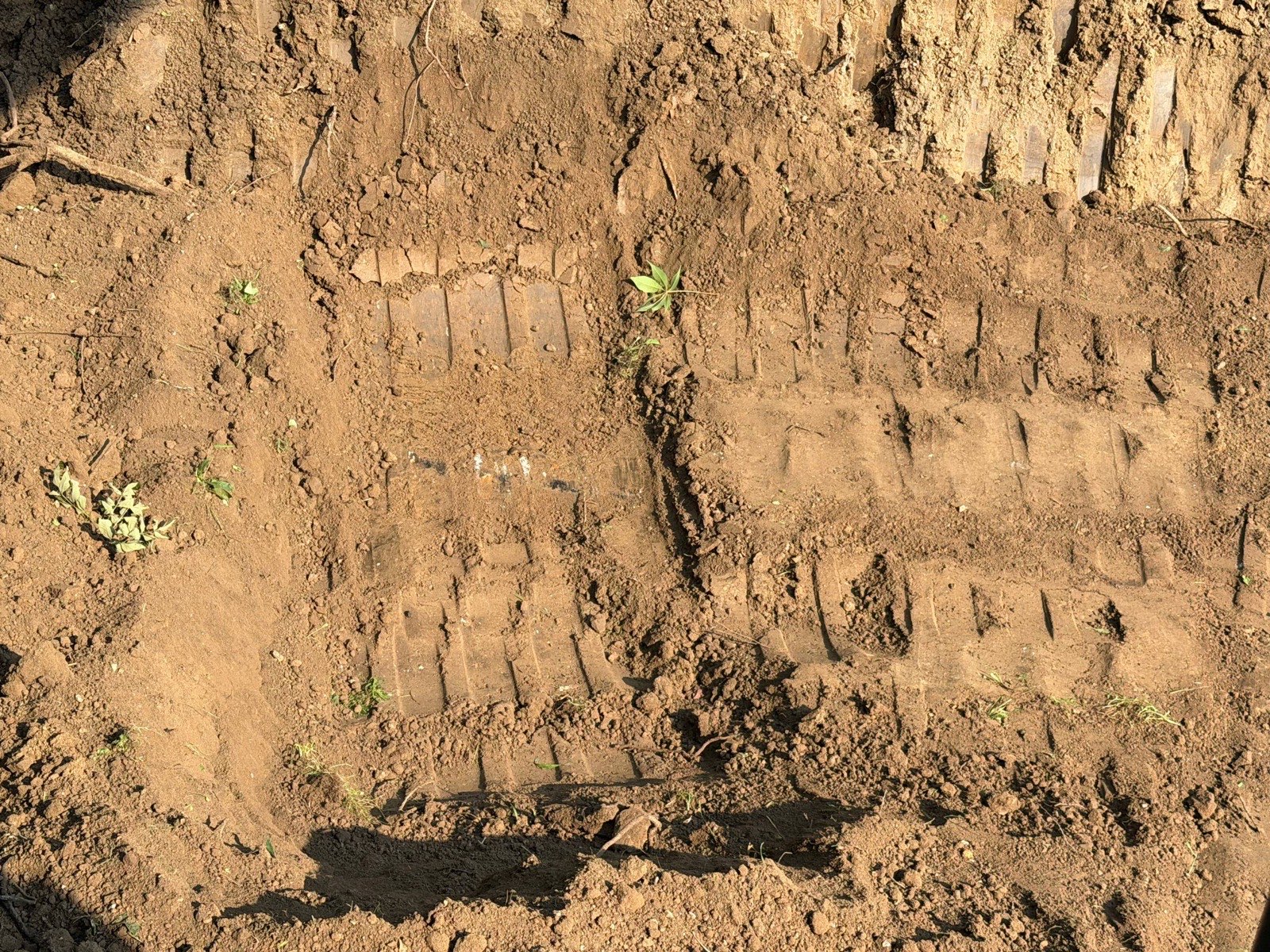
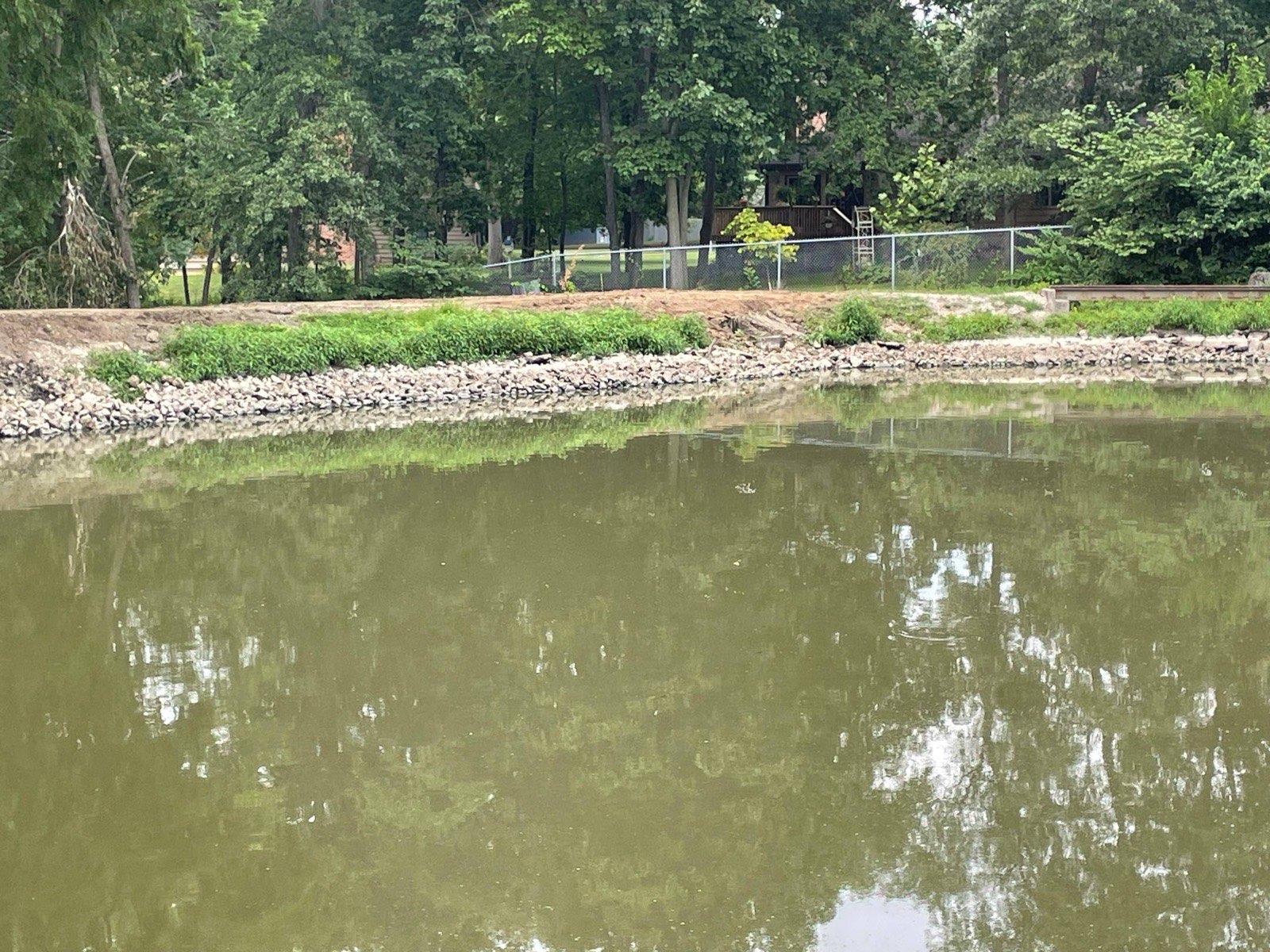
Multi-acre impoundments held by an earthen embankment: watershed sized first, core trench keyed into undisturbed ground, select clay in compacted lifts, and both outlets set to elevation before the first big rain finds them.
(217) 809-0779 📞 Free EstimateSearch for a lake contractor and you get engineering firms, reservoir consultants and a lot of material about municipal water supply. What most people around here actually want is several acres of water on their own ground, held back by an earthen embankment across a draw — built by an excavation outfit that will still be twenty minutes away in five years. That is us: Brohez Trucking LLC, Mattoon, working a 60-mile radius.
A lake is not a different technology from a pond. It is the same embankment, the same core trench and the same compacted lifts, with less room for error because there is more water behind it. What genuinely changes with size is how much has to be settled before a machine starts — the watershed, the spillway, and whether the state has an interest in the dam.
Before anything about shape, depth or acreage, there is one question that decides whether a site works at all: how many acres drain to it? That watershed has to deliver enough runoff to fill the pool and hold it up through a dry August — and not so much that the emergency spillway has to be a channel the size of a road.
Too little watershed and you get a basin that never comes up, or comes up in spring and drops a foot a month. Too much and every heavy rain is trying to take the dam out through the spillway. Both are site problems, not construction problems, which is why they get answered off the contours and the ground rather than after the dirt is moved.
This is also where a lake diverges hardest from a pond. A half-acre farm pond forgives a rough watershed estimate. Several acres of pool does not.
This is the whole thing. An embankment holds because the material reached density — it went in at the right moisture, in lifts thin enough to compact all the way through, with enough passes over each one. Nothing is laid into a dam to make it hold. There is no product that substitutes for the compaction, and fill that never reached density cannot be fixed later from the outside.
Moisture is the part people underestimate. Clay too dry will not knit no matter how many passes it gets; clay too wet pumps under the machine and never gains strength. The workable band is narrow, and hitting it sometimes means watering a lift or waiting a day. At lake scale that is not a delay to be squeezed — it is most of the reason the thing is still dry-footed in twenty years.
Below the ground line, the core trench does the other half of the job: a keyway cut down the centerline into tight undisturbed material and backfilled in the same compacted lifts, so water cannot travel under the embankment along the seam between new fill and the topsoil and root channels it was placed on.
Every impoundment we build gets two ways out. The principal outlet — the pipe through the embankment, with anti-seep collars set as the fill comes up around it — handles ordinary flow and holds the normal pool. The emergency spillway is the wide grassed channel that takes the storm the pipe was never sized for.
Leave it out and the water cuts its own spillway, over the crest, in the middle, in the first storm big enough to matter. The spillway belongs in undisturbed ground beside the embankment rather than through new fill, and it is cut to an elevation that is decided on paper before it is cut in dirt.
At lake size the spillway is not a detail at the end of the job. It is one of the numbers the whole design is built around.
Most farm ponds around here are not regulated dams. A lake is a different conversation, and it is worth having early rather than after a design exists.
Dam safety. Illinois rules under Part 3702 set the trigger on dam height and impounded storage together — a dam has to meet both parts of the test before the state regulates it. A bigger lake is far more likely to meet both than a farm pond is.
Stormwater. Disturbing an acre or more of ground brings a construction stormwater permit into the job. Lake-scale earthwork clears that line easily.
Local rules. Some counties treat a pond or lake over a set surface area as a special use, decided at the county rather than the state.
We are an excavation contractor, not a design firm. We will tell you plainly at the walk what we think applies and where you need an engineer — and we would rather lose the job to that conversation than build into a problem.
1. Walk the ground. Free, on site. Where the water comes from, where the embankment wants to sit, what the soil shows, and whether the site works at all — including the answer you might not want.
2. Watershed and layout. The acres draining in size the outlets and the spillway. Crest, normal pool and spillway elevation get set before dirt moves.
3. Strip the footprint. Topsoil, sod and root mat come off the embankment footprint down to firm native ground, stockpiled for the faces at the end.
4. Cut the core trench. A keyway down the centerline into undisturbed material, backfilled with select clay in compacted lifts. Depth is a call made in the hole, not on a map.
5. Build in lifts. Select material placed thin, moisture-conditioned, compacted lift by lift to crest elevation, with the outlet and its collars set as the fill comes up around them.
6. Spillway, faces and seed. Emergency spillway cut to elevation, faces dressed, topsoiled, seeded and mulched so the first rain lands on cover instead of bare fill.
There is no legal line in Illinois, and around here the words get used interchangeably. Practically, once you are past two or three surface acres the job changes character: the watershed has to be sized properly rather than eyeballed, the embankment gets tall enough that dam-safety rules come into the conversation, the earthwork stops being a few days and becomes a phased job, and the emergency spillway is carrying real water. We build the same way at both sizes. What changes is how much has to be settled before a machine starts.
We build earthen impoundments — the basin, the embankment, the outlets and the spillway — and the method is the same whether the pool is half an acre or several acres. Being straight with you: our photographed work is farm and recreation ponds and dam rebuilds, not a multi-acre lake. If you are planning something at lake scale we will tell you at the walk exactly which parts are ours, which parts need a design engineer, and whether we are the right outfit for it at all.
It can, and at lake size it is much more likely than for a farm pond. Illinois dam-safety rules under Part 3702 set the trigger on dam height and impounded storage together — a dam has to meet both parts of that test before the state regulates it, and a bigger lake is far more likely to meet both. Disturbing an acre or more of ground also brings a stormwater permit into it, and some counties treat a pond or lake over a set size as a special use. We tell you what we see at the walk and say plainly when something needs an engineer, because engineering is not our scope.
Bigger than most people expect, and it is the first thing worth knowing because it decides whether the site works at all. The acres draining to the site have to deliver enough runoff to fill the pool and keep it up through a dry summer, without delivering so much that the spillway has to be enormous. That number comes off the ground and the contours, not off a rule of thumb — and it is the question we answer first on the walk, before anything about size or shape.
No. Everything we build is a dry dig — the basin bottom stays above the water table and the pool is held by compacted clay and fed by runoff off the watershed above it. That is the only kind of impoundment we build, and it is the kind that behaves predictably in central Illinois ground.
Dry cleanout, yes — that means drawing the water down, letting the basin dry, and working it with a dozer and excavator on solid ground. That is real work we do. What we don’t do is work a basin under water, and nothing gets laid in the bottom to make it seal — a basin holds by density, so the fix is to scarify, moisture-condition and recompact the wetted face. If your lake has silted in, the honest first question is whether it can be drained and dried, because that decides whether it is a job at all.
Longer than a pond, and the honest answer is that weather sets the schedule more than the machines do. Fill has to go in at workable moisture, so a wet stretch stops the embankment whether or not iron is sitting on site. Lake-scale jobs usually get phased around that. We give you a realistic window at the walk rather than a best case.
Brohez Trucking. We build lakes across the 60-mile radius from Mattoon, IL — Champaign, Urbana, Decatur, Charleston, Effingham, Sullivan, Shelbyville, Tuscola, Arcola, Pana, Savoy, Mahomet, Rantoul, Fisher, and the farm ground between them. Free on-site walk before any number goes on paper.
A lake is a large, custom earthmoving project — cost comes down to acreage, depth, soil, the size of the dam, site access, and how much clearing the spot needs. There's no per-acre sticker price that's honest, because the cost is in the dam, not the hole. Two lakes with the same surface acreage can differ by a wide margin depending on how much material the embankment needs and how far it has to be moved. We walk it, take off real volumes, and give you an itemized number — and that walk is free. Call (217) 809-0779.
Often yes — an existing pond usually sits where water already wants to collect, which is the hardest part to find. Whether it becomes the deep end of a larger lake or gets rebuilt entirely depends on the existing dam and where the fill has to come from.
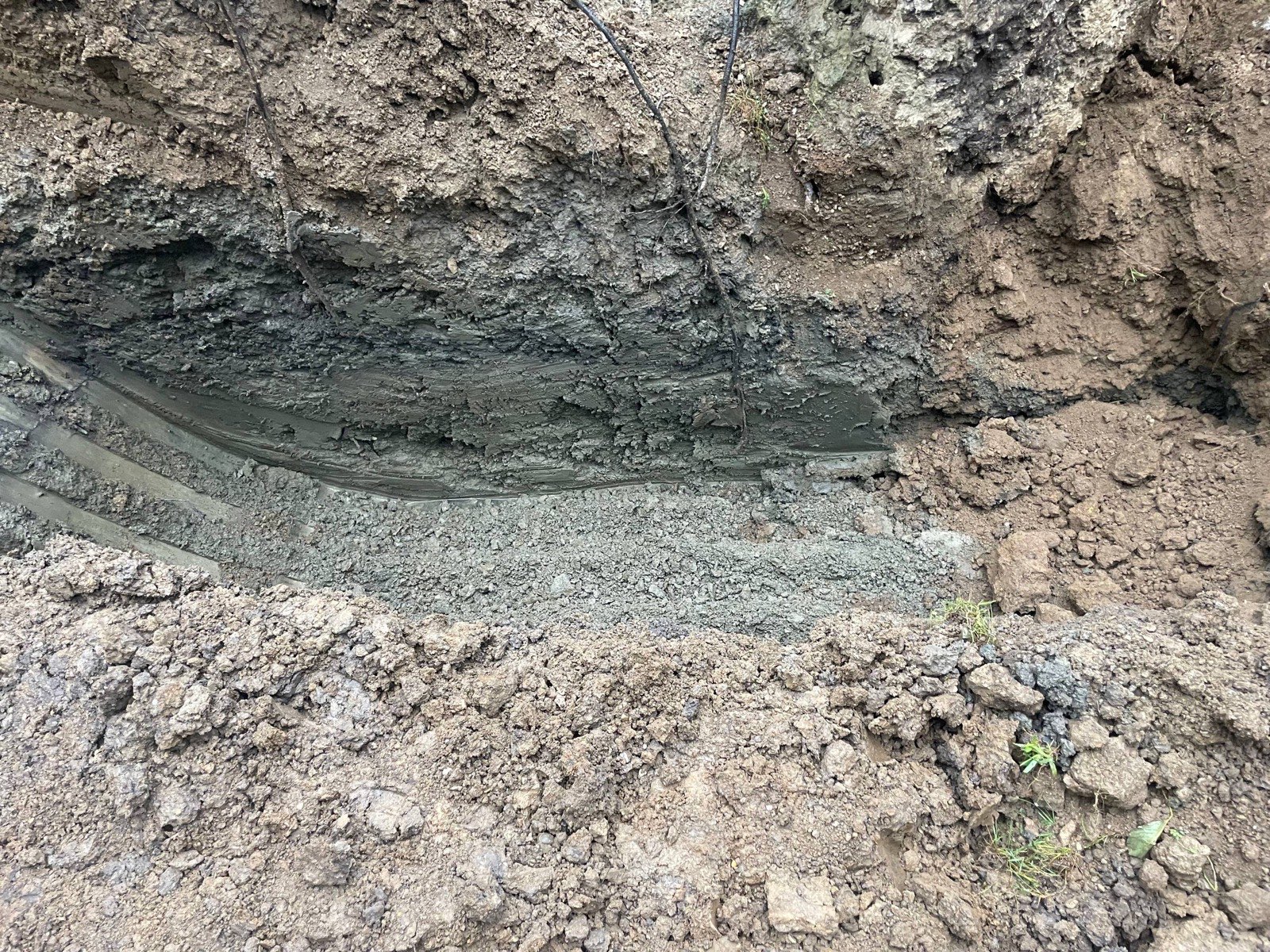
These are from a 40-foot dam rebuild near Decatur — a pond dam and a repair rather than a new lake, but the same core trench and the same compacted lifts an embankment of any size gets. It is the clearest set we have of what happens below the ground line.
Free on-site walk, a straight answer about whether the site works, and one itemized number. Call or text a photo.
(217) 809-0779 📞 Free Estimate