Want it fixed rather than explained? This is the guide. The service page is site grading & drainage — one crew and one estimate for the grading and the drainage together, with a free on-site look.
Standing water means the water has nowhere to go. If the ground is flat or pitched back toward the house, the fix is grading — reshape the surface so it drains away. If the yard already slopes right but water still stands, or the problem is underground, the fix is drainage — a French drain, yard drain, or tile. Most central Illinois yards need grading first, with drainage added where the surface alone can't move the water. We diagnose before we dig. Free on-site estimate: (217) 809-0779.
"There's a spot in my yard that won't dry out." We get that call a lot — after every heavy rain, from folks in Mattoon, Charleston, Champaign, and the country in between. And the first question people ask is usually the wrong one: "Do I need drain tile?" Maybe. But before you pay to bury pipe, it's worth knowing whether the real problem is the grade — the shape of the ground — because a regrade often fixes a wet yard with no pipe at all.
Here's the honest breakdown of grading vs. drainage, how to tell which one your yard needs, and why the answer is sometimes both.
Looking for someone to do the work rather than read about it? We're a grading contractor in central Illinois — yard regrading, pads and finish grade, with the pipe side handled by the same crew. Scope, equipment and process live on the site grading page. We take calls in Mattoon, Charleston, Champaign, Urbana, Decatur, and Effingham. Free on-site estimate: (217) 809-0779.
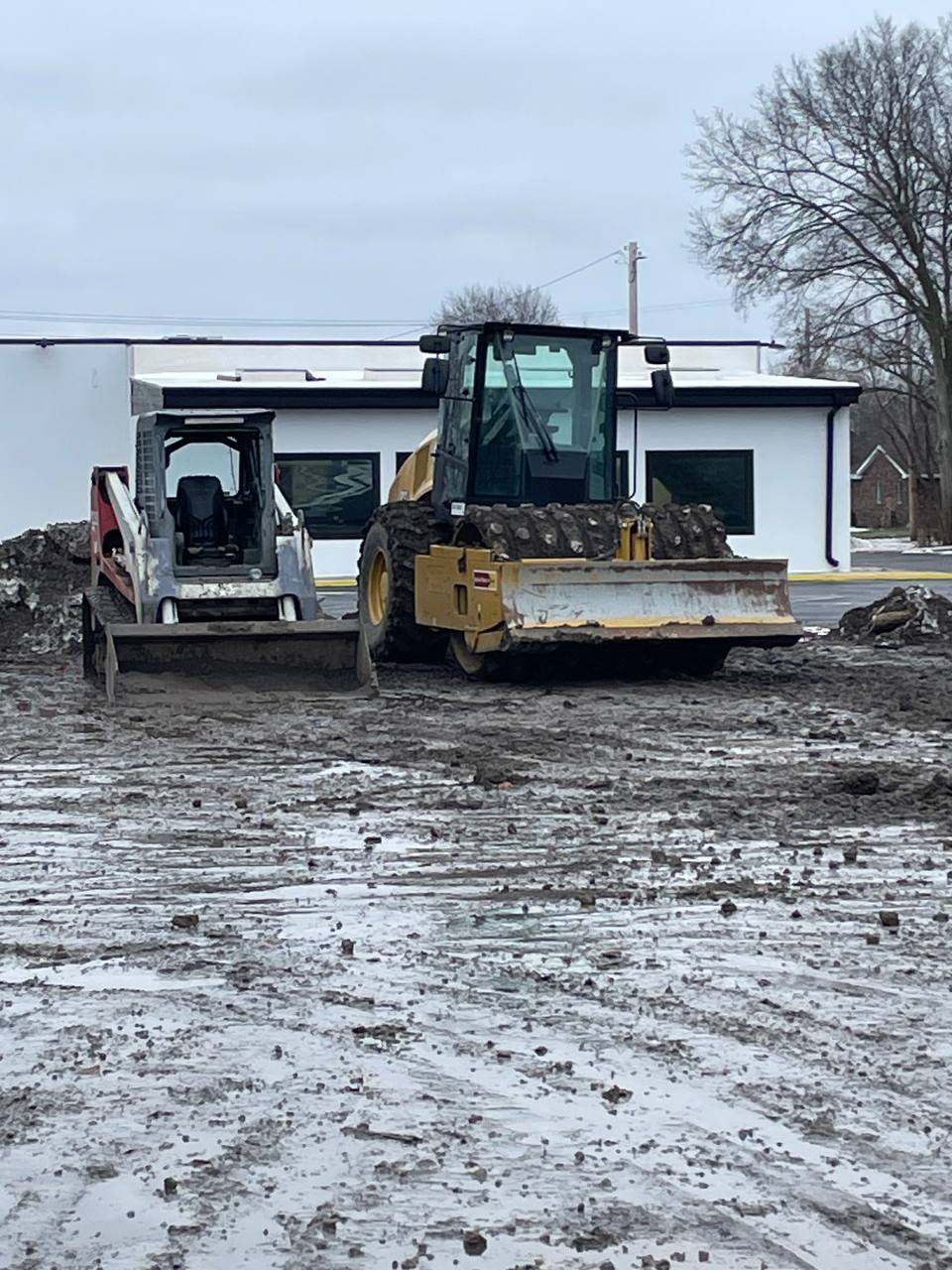
Standing Water Is Almost Always A "Nowhere To Go" Problem
Water moves downhill. That's the whole game. When it sits in your yard, one of two things is true:
- The surface won't send it anywhere. The ground is flat, dished, or actually pitched back toward the house, so rain that lands there just sits until it soaks in or evaporates. This is a grade problem.
- The surface sends it, but it can't get away. The yard slopes fine, but the water hits a flat run, a compacted layer, or a low corner with no outlet — or it's coming up from underground. This is a drainage problem.
Telling them apart is the entire job. Get it wrong and you either bury pipe a regrade would have fixed, or you smooth out a yard that was always going to need a drain. That's why we walk it first.
When The Fix Is Grading
Grading is reshaping the ground to a planned slope — cutting the high spots, filling the low ones, and re-establishing positive fall away from the foundation. If your standing water is a slope problem, this is the fix, and it's often cheaper and longer-lasting than pipe because there's nothing buried to crush, clog, or collapse.
Signs your wet yard is really a grading job:
- The yard is dead flat, or you can see it tilts toward the house.
- Water pools in a broad, shallow sheet rather than one deep spot.
- A downspout dumps right next to the foundation and the ground doesn't carry it away.
- A previous excavator or builder left the yard rough, rutted, or back-pitched.
- The low spot has somewhere lower nearby it could drain to — if only the surface connected them.
On the flat ground that dominates central Illinois, the correction is often small — a couple of percent of slope is all it takes — but it has to be right, and consistent. That's where the equipment earns its keep.
Yard Grading vs. Land Grading — Same Job, Different Ground
Folks use both terms and mean roughly the same work, so it's worth clearing up. Yard grading is what you're doing when the ground in question is a lawn — around the house, the shed, the patio — and the goal is positive fall away from the foundation. Land grading is the same reshaping on open ground: a bare lot, an acreage, a pasture, a new-build site before anybody pours anything. Same dozer, same laser, same crew — it's the same phone call either way. Scope, equipment and service area for both live on our grading page.
When The Fix Is Drainage
Sometimes the surface is doing its job and the water still won't leave. That's when you add drainage — pipe that collects the water and carries it to a real outlet:
- French drain: perforated pipe in washed stone that intercepts water moving through the ground and carries it off — great for a hillside seep, a soggy strip along the foundation, or a yard too flat to shed water by surface alone. We break it down in French drain vs. surface drain vs. field tile.
- Yard drains & catch basins: a grate at the low spot that swallows the water and pipes it away underground.
- Downspout tie-ins: connecting gutters to buried pipe so roof water is carried well away from the house instead of dumping at the corner.
- Field tile repair: on farm ground and big lots, a broken or collapsed tile line brings wet spots back — we locate and repair the tile to restore flow.
Drainage is the right call when the yard already slopes correctly, when the water is subsurface, or when there's simply no surface path to a lower outlet. The key is that every drain has to actually go somewhere — a ditch, a swale, a lower grade, a proper outlet. Pipe that dead-ends underground just moves the puddle.
Usually, It's Both — And That's The Point
Here's the part the "just install drain tile" advice misses: on most central Illinois yards, the best fix is the surface and the pipe working together. Reshape the surface so the bulk of the water sheds away on its own, then add a French drain or yard drain exactly where the surface can't finish the job. You end up with less buried pipe, a yard that drains on its own most of the time, and a system that isn't relying on a single line staying clear forever.
That's the advantage of having one contractor who does both. We're not a drain-pipe company that grades a little, or a dozer outfit that sends you elsewhere for the pipe. We do grading and drainage off one estimate, one crew — so the recommendation isn't shaded by what we happen to sell. If a regrade solves it, we'll tell you, and you won't pay for pipe you didn't need. Not sure why the water keeps pooling in the same place? Our post on why water stands in your yard walks through the usual causes, and what drives yard drainage cost covers what goes into a number.
The Honest Conversation
Here's what I tell people on the phone: don't buy a solution before anyone's looked at the water. We come out, watch where it runs and where it stops, check the fall with a level or the laser, and figure out whether your yard has a slope problem, a drainage problem, or both. Then you get a straight recommendation and a free estimate — no pressure, no upsell to pipe you don't need.
You deal with the owner, not a call center: your job is run by Levi Brohez, owner-operator — the man on the machine is the man you talk to.
Got a spot that won't dry out? See our grading page — that's where the work, equipment, and process live — or our drainage page, or call (217) 809-0779 and we'll come look at it.